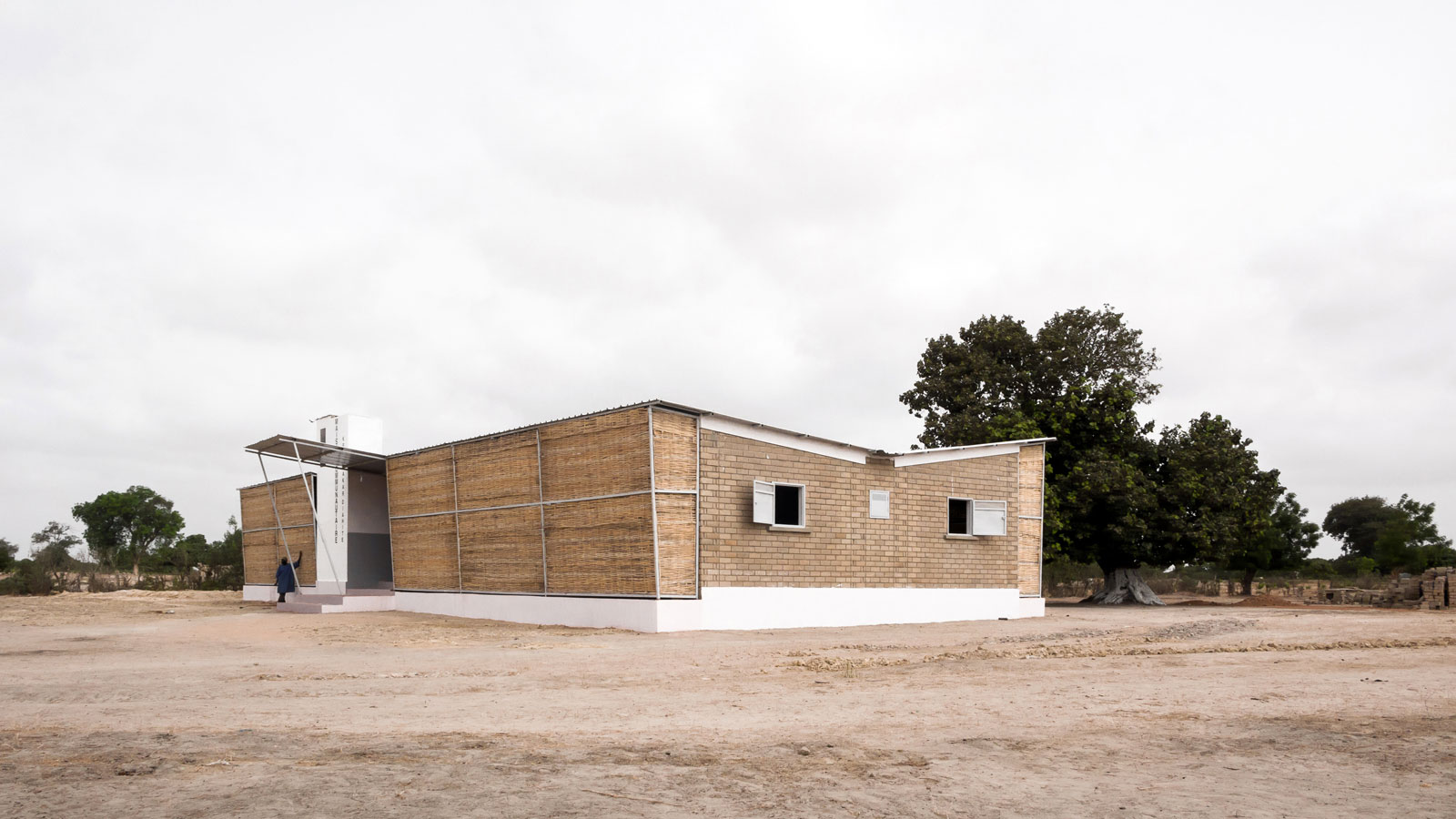
Enviu selected Emerging Ghana by Ana Morgado, João Caeiro, Lara Camilla Pinho, Maria de Paz Sequeira Braga and Maria de Carmo Caldeira, from Portugal, Mexico and Brazil, as the winner of the Open Source-House competition. The materials used are bamboo and dahoma, a local wood, for the modular and lightweight panels. These are held together with strong rammed earth walls. Due to the modular design, inside and outside spaces can be created depending on different needs and environments. Natural ventilation is archived throughout the building, due to the earth walls that keep the spaces cool and shaded areas.
Further Improved Rammed Earth Stoves, or F.I.R.E.S., are promoted by the East Africa Trust as a way to improve self-sufficiency and sustainability in Malawi, Kenya, Tanzania, Rwanda, Mozambique and beyond.
The Musgum, an ethnic group in far north province in Cameroon, create their tall conical dwellings from compressed sun-dried mud. Called Cases Obos, the profile of the structure is that of a catenary arch— the ideal mathematical form to bear a maximum weight with minimal material.
The relief pattern on the surface is a built-in scaffolding that can support the body to allow for maintenance of the structure by the re-application of mud to the surface.
The conflict over water and land in Sudan has created political unrest for decades. However, in 2007, scientists from Boston University discovered and underground lake in the region of Darfur, Sudan. This lake is tenth biggest lake in the world (31, 000 m2) and would have great potential in resolving the conflict if managed correctly. Addressing this water issue, Polish architect Hugon Kowalski from H3AR Architect and Design recently proposed a building that allows access to underground waters through the application of water pumps. The form of the building was inspired by a water tower and also by the symbol of the African savanna—the baobab. The building houses water pumps, a treatment plant but also a hospital, a school and a food storage center. This building is meant to provoke economical development but also stimulate cultural exchange and the coexistence of the three different religions and languages in Sudan.
The building walls are constructed using compressed dry stacked clay bricks, made on site using a rough mixture of earth, cement and water. The bricks would be baked in the hot sun, thus, requiring no extra energy and limiting the environmental impact of the materials. The choice of using this technology represents the desire to introduce alternative and sustainable technologies within a context that is tied to standardized though not always optimal building practice.
Two water circulation processes would be in place. First set of extracted water is meant to heat or cool the building, and is accessible to the users. Second, set of extracted water is used for the building itself (i.e. kitchen, toilets).
Dune Anti-Desertification Architecture investigates adaptive (as opposed to mitigatory) strategies leading to the creation of a climate-conscious
architecture that responds to the extreme environments of tomorrow’s globally-warmed world. Highly speculative yet buildable, the scheme aims to find innovative solutions to combat desertification in the Sahel region of Africa, where sand dunes are currently moving southward at a breathtaking
pace of around 600m per year, ruining the land and making it impossible for the inhabitants of this area to make a living or even stay in their homes. The forced migration of desertification refugees is perhaps more threatening in Nigeria than anywhere else. With a population of over 140 million people, Nigeria is the most populous country in Africa, with serious desertification issues throughout its northern states. It was Nigeria’s former president, Olusegun Obasanjo, who initiated the anti-desertification Green Wall Sahara initiative in 2005. This pan-African scheme seeks to plant a shelterbelt across the continent, from Mauritania in the west to Djibouti in the east, in an attempt to stop the dunes from migrating. The trees are being planted right now.
An architectural response to this campaign would be to go beyond the mere planting of a mitigatory shelterbelt. Habitable spaces can be created in close proximity to the trees. By cutting through the sand dunes and digging down to find water and shade, an artificial oasis can be formed underground.
The sand is solidified using bacillus pasteurii, a microorganism with which professor Jason DeJong has turned sand into sandstone in a mere 1,400 minutes. This technology of organically cementing networks of sand dunes into habitable barriers that stop the desert from spreading has never been proposed before, but on hearing about this project, the professor was enthusiastic: “I do think the application you are talking about is possible”. I’m proposing anti-desertifi cation structures made out of the desert itself, sand-stopping devices made of sand: a poetic proposal that simultaneously works in a sustainable way with local materials and assets.
Special emphasis has been put on finding a solution that is high-tech in result but low-tech in application and construction, with the economical scenario being hard to pin down as this method is virgin territory. It is recognized that poor people are highly vulnerable to the effects of weather, as drought can cause famine while good rains can cause drops in crop prices. The architecture presented here could form a stable base from which to fight back against both effects.
Mumemo is a blog about a training course carried out in Mumemo (Maputo, Mozambique) on earth construction by two Portuguese architects, Miguel Mendes and Teresa Beirao, during May and August 2006. The project was created for the inhabitants of a new village, created as a resettlement for the victims of the massive floods in the year 2000. The course gave students a wide and solid knowledge about earthen construction and three main techniques (rammed earth, adobe, compressed earth blocs) as well as provided them with the ability to direct similar courses in other communities. During the course, a small 50m2 house was built.
The West African village of Nionsomoridou , Guiea doesn't have running water or electric lights. Most people get here by walking barefoot along a dirt path. The remote mountain community has one up-to-the-minute feature, though: a housing bust. Rents had risen in recent years, and local residents and home builders let their enthusiasm get the better of them, turning out a spate of new construction. Now, rows of newly built houses stand empty in the village, and rents have been cut in half. So far, not so different from Miami or Phoenix. Except that these homes are one-room, windowless mud-brick huts, and the rent is about $6.50 a month.
For centuries, Nionsomoridou faced no risk of a housing-market crash, because it didn't have a housing market. There were no unused houses. If a son married and needed room for children, his relatives put up a new hut next door, on village land that is communally owned. Then came the global commodities boom, with far-reaching effects on Nionsomoridou, situated deep amid lushly forested mountains rich in gold, diamonds and one of the world's largest virgin iron-ore seams.
Pigeon is a part of the daily diet in many parts of Egypt and Pigeon houses, or dovecotes, are constructed from mud brick create an artificial mountainous topography. The droppings are also a valuable source of fertilizer and the houses are so ubiquitous that they are also part of the Egyptian national identity. The dovecote typology can be found throughout the world and Earth Architecture has previously featured the palomares of Spain.
Interestingly, the Egyptian pigeon houses remind one of the recent work of architect Vicente Guallart, who in his project The Re-Naturalization of Territory, attempts to create what could be considered as dovecotes for biotechnology and cinema in Tarragona, Spain.
Completed in 15 months by a local builder, under the direct supervision of FAREstudio, the CBF is functionally and cost-effective answer to the needs expressed by AIDOS, while simultaneously and primarily representing a centre of aggregation and identity for the entire local community.
The building walls are constructed using compressed dry stacked clay bricks, BTC [briques en terre comprimée], made on site using a rough mixture of earth, cement and water. The bricks were baked in the hot sun, with no energy consumption, thus limiting the environmental impact of the material.
A team carried out a detailed design of structural vaults built from local soil for a new museum at the World Heritage Site of Mapungubwe in South Africa designed by Peter Rich Architects. Michael Ramage (Cambridge), John Ochsendorf, and Philippe Block designed the unreinforced structural masonry vaults in collaboration with Henry Fagan in South Africa. Matthew Hodge developed the cement-stabilized tiles in collaboration with Anne Fitchett (Univ. of Witwatersrand). Based on his experience building the domes of the Pines Calyx in the UK, James Bellamy supervised the vault construction on site. The project was part of masonry research conducted by MIT.
In each village in Dogon Country, Mali exists a large family dwelling, called a ginna, that is reserved for the spiritual leader of the community. The building has a raised living area reached by a ladder carved from a tree trunk. The windowless facade is decorated with 80 niches, representing the original ancestors and their descendants. The two doors are often carved with rows of male and female figures which, like the niches, symbolize earlier generations. Inside this building, some altars and a small shrine form the focus of the clan cult. In most Dogon villages, the head of a clan lives in the gina until his death.
A curious relationship between mud brick architecture and the automobile exists in two very important earthen architecture building cultures: among the Ndebele people of South Africa, whose vividly painted mud brick houses have been transposed to the automobile, and in northern New Mexico where the descendants of the Spanish colonists created a unique style of mud brick architecture from which emerged the invention of the lowrider.
Ndebele
The Ndebele people of South Africa are famous for the the colorful patterns applied to the exterior of their houses, which are made of a mixture of dung, mud, and clay. Their distinctive house-painting style, originally based on a similar but less colourful style originally developed by the Northern Sotho or Pedi, flowered and achieved its creative pinnacle within the almost slave-like conditions which the Ndebele endured on the white-owned farms of the south-eastern Transvaal during the late 19th century and the first half of the 20th century.
The almost exclusively female creators of these arts have for decades been borrowing elements from the social and cultural repertoires both of their neighbours and of modern industrial society. Peter Rich writes, "The strength of Ndebele spatial models and aesthetic grammar allowed them to invest images reinterpreted from other cultures, with their own symbolic meaning. They had an affinity with the stylised art deco that was prevalent in cities such as Pretoria in the 1940s and '50s. The changing trends in Western society, notably the American car culture of the '50s, fashion and infatuation with images of power/electricity/jet aeroplanes, were other catalysts. 'We see what we want to see and make it our own', proclaims a Ndebele matriarch."
Application of paint to earthen wall
Because of the striking designs adorning the houses, tourists drove great distances to see the Ndebele, often from as far away as Johanasburg, which was 100 miles away. According to Elizabeth Ann Schneider, the Ndebele women noticed the license plates on the cars and although they could not read them, they liked the shapes of the letters and numbers and began to paint them on their earthen walls. They mirrored the shapes of these forms to create symmetrical patterns on the front of their houses. Wavy designs known as "tire tracks" are still sometimes applied to walls and also appear on floors.
Modern "BMW" Ndebele House
‘Mural decoration is the prerogative of the woman; it denotes her unique and intimate relationship with the indlu (home) and her passive response to being exploited socially and politically,’ wrote Margaret Courtney-Clarke in Ndebele, but with the pressures of a modern era, the Ndebele women became increasingly dependent upon the automobile to find work in cities that were a good distance from their villages. This cultural shift led to the application of Ndebele motifs, which until then used the car as inspiration, to the car itself.
Many Ndebele women became well known for their craft and the most celebrated of these artists is Esther Nikwambi Mahlangu. Born in Middleburg in 1936, she was invited in 1989 to exhibit at the Pompidou Art Museum in Paris. In 1991, she was invited to paint a prototype of the new BMW 525i model. Esther's car, eleventh in the Art Car Collection, was the first to be decorated by a woman artist and as a black woman artist from a little-known South African community to be included in a prestigious international artistic line-up of artists including Frank Stella, Roy Lichtenstein, Andy Warhol and David Hockney made this fact all the more exceptional.
Esther Mahlangu's Ndebele BMW
In 2008 Mahlangu was invited to paint another car—this time the new Fiat 500.
Mahlangu next to her Fiat 500
Today, calling attention to the automobile's long relationship with the the architecture of the Ndebele, an old car, painted in this evolving tradition, joins a sign announcing the entrance to the famous mud brick village of Lesedi.
Mud brick was he principal building Northern New Mexico from the founding of the first colony in 1598 until the mid 20th century. Industrialization, mining and the lure of jobs in cities transformed what was largely agrarian society in New Mexico into a society increasingly dependent upon the automobile to travel the great distances from the isolated villages to Albuquerque and the mines in central Colorado.
From the desire to bring with them a piece of home with them from a landscape in which the people were deeply rooted, emerged the lowrider—a chapel on wheels that evoked the essence of the ancient baroque mud brick churches that were at the center of village life.
Dave's Dream as displayed in the Smithsonian Museum’s former Road Transportation hall, with photomural of the El Santuario de Chimayo, and an assembly of trophies won by this lowrider automobile. Photo by Jeff Tinsley, Negative #: 95-3340
The altar of El Santuario de Chimayo whose color scheme and ornamentation could be seen as influential to "Dave's Dream"
The long lines of automobiles produced in the 40's, 50's, 60's and 70's were reminicent of the longcorrieras—adobe houses that were composed of several branches of a single family constructed through a series continuous additions as the family grew. The interiors and/or exteriors of the car were often lavishly ornamented, reminiscent of the baroque ornamentation found in the mud brick interiors.
Ruin of a corriera house in San Idelfono, New Mexico and a 1963 Impela.
Low-rider Cadillac named "Chimayo," Chimayo, New Mexico, 1997 by Craig Varjabedian
Today, the mud brick village of Chimayo, New Mexico is considered the spiritual center of the lowrider world and nearby Española, New Mexico is considered the lowrider capital of the world. Today lowrider culture has become a global phenomena, but the ornate vehicles and over-zealous use of hydraulics that tilts the automobiles into torqued positions still recall the leaning ancient mud brick structures of northern New Mexico.
And while lowriding has become a serious artform and mud brick architecture has roots in the profound, the combination of adobe architecture and the automobile has also been poked fun at in popular culture as evidenced by the adobe car, featured in a Saturday Night Live "fake commercial", a transcript of which appears below:
Saturday Night Live's The Adobe Car
Spokesman: These days, everyone's talking about the Hyundai, and the Yugo. Both nice cars, if you've got $3,000 or $4,000 to throw around. But, for those of us whose name doesn't happen to be Rockefeller, finally there's some good news - a car with a sticker price of $179. That's right, $179. The name of the car?
Adobe. The sassy new Mexican import that's made out of clay. German engineering and Mexican know-how helped create the first car to break the $200 barrier. At this price, you might not expect more than reliable transportation - but, brother, you get it! Extra features: like the custom contour seats, or the beverage-gripping dash. And the money you save isn't exactly small change!
Jingle:
"Hey, hey, we're Adobe!
The little car that's made out of clay!
We're gonna save you some money
that you can spend in some other way!
Hey, hey, we're Adobe!
Adobe!"
[ show Adobe driver get into a fender-bender. She casually steps out of the vehicle and uses her hands to mold her bumper back into its proper shape, in under six minutes! ]
Spokesman: Adobe. You can buy a cheaper car. But I wouldn't recommend it!
Announcer: Not approved for street use in some states. No warranty either expressed or implied. All sales final.
Interestingly, most major automobile manufacturers actually employ clay to visualize their designs before they go into production. This art of designing cars in clay has existed since the 1920's, just as the Industrial Revolution was beginning to influence the culture of the remote villages of Northern New Mexico and still today, most of the futuristic prototypes found at car shows are clay models crafted with multiple axis computer controlled mills that carve the car from clay based on designs created using 3D modeling software.
High Speed CNC Machine
And as sophisticated machinery is being developed to shape the automobiles of the future out of clay, cumbersome vehicles exist that move across flat terrains, which consume mud and excrete large quantities of mud brick to fuel a growing demand for adobe houses in New Mexico and beyond. Such machinery can be found at The Adobe Factory in Alcalde, New Mexico and can produce 20,000 mud bricks per day.
Following the success of his design for a Primary School in Burkina Faso, which prompted growing numbers of students attending the school, architect Diébédo Francis Kéré has completed an extension to the school using many of the same techniques and materials, but with an innovative new compressed earth vault protected by an airy vaulted metal canopy. In addition to classrooms, the extension also houses a kitchen and library.
Orange Farm is a township in the southwest of Johannesburg. The social situation is characterised by poverty, AIDS and unemployment. The appearance of the development is dominated largely by buildings or shacks made mostly of sheet metal, corrugated iron or parts of cars. In summer it can become unbearably hot in these shacks (up to 45°C), while during winter nights it can be noticeably cold (to 2°C).
BASE habitat was commissioned by the Tebogo Home for Handicapped Children. The Austrian NGO SARCH set up this contact for us. The home for almost 50 children had become too small. In a group of 25 students we planned and built a dining building with a new kitchen, and a therapy building with sanitary facilities. A generously dimensioned pergola, a garden hall, connects the buildings with each other. The buildings we erected in Tebogo have a pleasant indoor climate throughout the year – without the use of energy. In this way we were able to reduce the fluctuation in temperature to only 9°C. Local workers, above all women, were integrated in the project. The building materials were acquired directly from the township: concrete blocks, earth, clay, straw, timber, grass mats – to strengthen the local economy and to make later repetition easier. One of the main aims was to make buildings that suited the needs of the children. They received a home that conveyed a sense of security and joy in living.
The impact of Koudougou's Central Market, designed by the Swiss Agency for Development and Cooperation (SDC) / Laurent Séchaud / Pierre Jequier for the Koudougou Municipality and completed in 2005, is twofold: at the urban scale, it reinforces and enhances the fabric of a mid-sized town, providing a monumental civic space for commercial and social exchange. On the level of construction, it introduces simple and easily assimilated improvements to a traditional material - stabilised earth - which allow it to achieve its full aesthetic and environmental potential. By using blocks of compressed earth, the market not only demonstrates the superior climactic performance of the local building material, but also shows how humble earth blocks can be used to create a sophisticated pattern language of vaults, domes and arches.
The market is the third of its type to be built under the direction of the Swiss Agency for Development and Cooperation (SDC) in cooperation with the Programme de Développement des Villes Moyennes of the Burkina Faso government, which aims to strengthen the country's mid-sized towns through building commercial infrastructures. The market was the result of a truly participatory process that brought together and engaged the entire community in the site selection, design and construction of the market as well as its continuing use. A 1:1 prototype of a typical retail space was constructed which helped facilitate communication between the different collaborators, simultaneously allowing refinement of the design, development of innovative construction techniques and practical training of the local masons.
Synopsis
Currently it is estimated that one half of the world's population—approximately three billion people on six continents—lives or works in buildings constructed of earth. And while the vast legacy of traditional and vernacular earthen construction has been widely discussed, little attention has been paid to the contemporary tradition of earth architecture. Author Ronald Rael, founder of Eartharchitecture.org provides a history of building with earth in the modern era, focusing particularly on projects constructed in the last few decades that use rammed earth, mud brick, compressed earth, cob, and several other interesting techniques. EARTH ARCHITECTURE presents a selection of more than 40 projects that exemplify new, creative uses of the oldest building material on the planet.
An engaging narrative addresses the misconceptions associated with earth architecture. Many assume that it's only used for housing in poor rural areas—but there are examples of airports, embassies, hospitals, museums, and factories that are made of earth. It's also assumed that earth is a fragile, ephemeral material, while in reality some of the oldest extant buildings on the planet are made of earth. The book also touches on many topics that pervade both architecture and popular media today, such as the ecological benefits and the politics of building with earth, particularly in developing nations where earth buildings are often thought of as pre-modern or backward. With captivating discussion and more than 300 images, Earth Architecture showcases the beauty and simplicity of one of humankind's most evolved and sophisticated building technologies.
ISBN 9781568987675 8.5 x 9 inches (21.6 x 22.9 cm), Hardcover, 208 pages 222 color illustrations; 96 b/w illustrations; A PAPress publication.
About the Author
Ronald Rael is an Architect, Author and Assistant Professor of Architecture at The University of California, Berkeley. He is the founder of EarthArchitecture.org, a clearing house of information on the subject.
EARTH ARCHITECTURE — THE WEBSITE
Dirt—as in clay, gravel, sand, silt, soil, loam, mud—is everywhere. The ground we walk on and grow crops in also just happens to be the most widely used building material on the planet. Civilizations throughout time have used it to create stable, warm, low-impact structures. The world's first skyscrapers were built of mud brick. Paul Revere, Saddam Hussein, Chairman Mao, and Ronald Reagan all lived in earth houses at various points in their lives, and several of the buildings housing Donald Judd's priceless collection in Marfa, Texas, are made of mud brick. The Earth Architecture website focuses on architecture constructed of mud brick (adobe), rammed earth (pisé), cob, compressed earth block or other methods of earthen construction and serves as a database for the discussion and dissemination of events, resources, and images of earth architecture in the context of contemporary architecture culture.